
Streaming
The agent announces a file and Caronte transfers it directly from source to destination without retaining it in the Data HUB.
Product · Managed File Transfer Data HUB
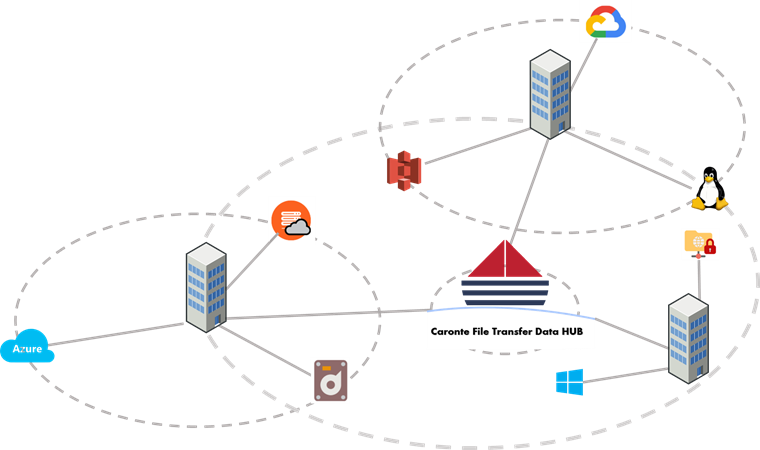
Caronte governs data transfer across heterogeneous systems through one operating model: endpoints, flows, schedules, identities, storage, outcomes and audit. Caronte Bridge and CaronteCLI extend the platform to protocols, servers, and Linux or Windows environments.
Data HUB
An enterprise file transfer is not merely a connection between two folders. It is a chain of sources, destinations, rules, time windows, credentials, checks and outcomes. Caronte makes that chain configurable and readable from one place, without forcing every system to speak the same protocol.
The platform separates how data is moved from how the transfer is governed.
The agent announces a file and Caronte transfers it directly from source to destination without retaining it in the Data HUB.
The file is acquired into object storage and forwarded to its destination, decoupling source availability from delivery.
A command line or external scheduler requests the transfer while control, records and outcomes remain centralised.
FTP, FTPS, SFTP, HTTPS, WebDAV, S3, SMB, email, object storage and cloud services enter the same flow model.
CaronteCLI runs as a service, on events or in batch, connecting local directories and network shares to the platform.
mTLS for agent communication, SSH keys and PGP support protect both transport and content.
Portal, job scheduler, database, object storage and Bridge can run on a single node or in a clustered architecture.
REST APIs and CLI tools create endpoints, manage flows and integrate Caronte into operating procedures.
Flow records, health checks, alerts and post-execution actions make each delivery observable and actionable.
Architecture
The portal governs configuration and operations; the job scheduler executes workflows; the database and object storage maintain state and data; Caronte Bridge exposes protocols; CaronteCLI brings the Data HUB close to systems that produce or receive files. The result is one control plane above infrastructure that can remain heterogeneous.
Next step